The Beat You're Moving To Might Be Breaking Your Body Down

You spent twenty minutes building the perfect playlist. You've got the high-energy opener, the mid-workout anthem, the "I'm not dying yet" closer. It slaps. You feel unstoppable.
But here's the thing nobody talks about at the gym: the music you're listening to isn't just motivating you. It's actively influencing how you move. And depending on what's playing, that influence might not be doing your joints any favors.
This isn't about whether music helps you push harder — it clearly does. It's about whether the rhythm you're locked into is syncing with your body's natural movement patterns or quietly working against them.
Your Body Already Has a Rhythm — Whether You Notice It or Not
Before we talk playlists, let's talk proprioception. That's your body's ability to sense where it is in space — the internal GPS that tells your foot how to land, your knee how to track, and your spine how to stay stacked. It's always running in the background, making thousands of micro-adjustments every time you take a step, swing a kettlebell, or push through a squat.
Here's the catch: proprioception is sensitive to external input. Sound, rhythm, and beat patterns can actually shift how your nervous system organizes movement. Research published in sports science journals has consistently shown that synchronizing movement to an external beat — what researchers call "entrainment" — changes stride length, cadence, joint loading, and even perceived exertion.
That's powerful. But it cuts both ways.
When the rhythm you're locked into matches your natural movement tempo, things flow. Your cadence stays efficient, your breathing syncs up, and your body isn't fighting itself. When the beat is slightly off — too fast, too chaotic, or inconsistently syncopated — your nervous system starts chasing it. And that's where the trouble starts.
What Happens When Your Feet Can't Find the Beat
Imagine you're running at a comfortable pace — somewhere around 160 steps per minute. You've got a track playing at 175 BPM. Your brain, being the pattern-seeking machine it is, tries to match that beat. So you shorten your stride, increase your turnover, and subtly change your gait without ever consciously deciding to.
For some people, that nudge toward a faster cadence is actually helpful — it can reduce overstriding and lower impact forces on the knees. Sports physical therapists have used this principle for years in gait retraining.
But crank the BPM too high, or throw on something with an erratic beat structure, and you're asking your body to organize movement around a rhythm it can't actually sustain. The result? Compensations. Sloppy mechanics. Muscles firing out of sequence. And over time, the kind of repetitive stress that shows up as IT band tightness, knee pain, or a hip that just won't quit.
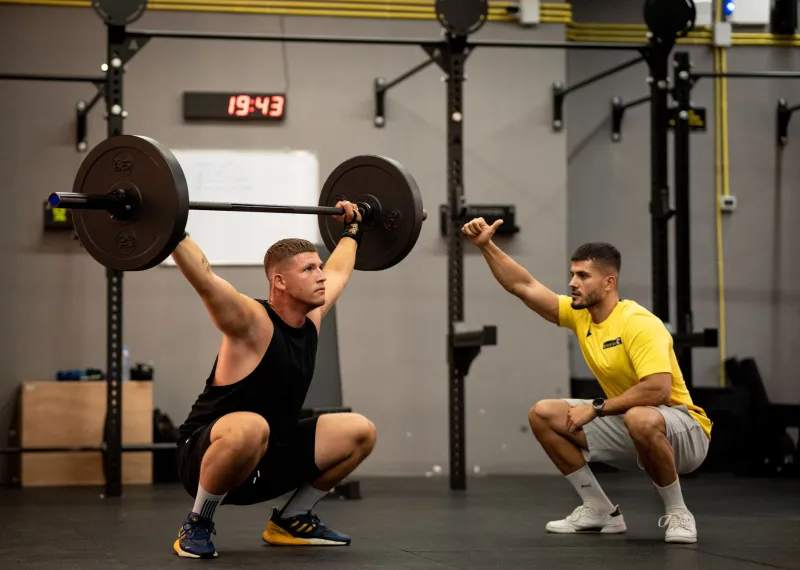
The same principle applies to strength training. If you're performing a slow, controlled Romanian deadlift and an 180 BPM trap banger drops, your tempo is going to drift. You'll rush the eccentric. You'll lose tension at the bottom. You'll start moving like you're in a music video instead of protecting your lumbar spine.
Tempo vs. Rhythm — They're Not the Same Thing
Here's where most fitness advice gets it wrong: people focus entirely on BPM (beats per minute) as the magic variable. Pick the right BPM, the thinking goes, and you're set.
But BPM is just tempo — the speed of the beat. Rhythm is the feel of it. The groove. The way accents fall within a measure, how syncopation creates tension, and whether the overall pattern feels steady or unpredictable.
A track at 140 BPM can feel grounding and smooth, or it can feel jagged and anxious depending on how it's produced. Hip-hop and house music might share a similar BPM range but create completely different movement responses in the body. One might help you settle into a lift; the other might make you feel like you're trying to outrun something.
For movement quality, steady and predictable rhythm almost always wins over complex syncopation during technical work. Save the off-beat, polyrhythmic stuff for when you're doing something that doesn't require precise motor control — like a stationary bike warmup or a casual walk.
A Practical Framework for Building a Smarter Playlist
You don't need to become a musicologist. You just need a loose framework that matches your audio environment to what your body is actually doing.
Warm-Up (First 10–15 Minutes) Keep it moderate — somewhere in the 100–120 BPM range. You want something that encourages smooth, rhythmic movement without spiking your nervous system before your tissues are ready. Think downtempo hip-hop, lo-fi beats, or mid-tempo R&B. The goal is to ease your proprioceptive system online, not shock it awake.
Technical Strength Work This is where most people make the biggest mistake. When you're doing anything that requires deliberate tempo — deadlifts, squats, overhead pressing, single-leg work — consider dropping the music volume or switching to something with a slower, steadier groove. Instrumental tracks work well here because there are no vocals to pull your attention away from internal feedback. You need to feel the movement, not perform to a beat.
Cardio and Conditioning This is where higher BPM music earns its place. For running, 160–180 BPM tends to align well with natural running cadences and can actually improve efficiency. For cycling, rowing, or circuit work, match the BPM roughly to your target movement pace. Steady, driving rhythms — think classic rock, pop-punk, or straightforward electronic — tend to support consistent output better than heavily produced tracks with lots of drops and tempo changes.
Cooldown and Mobility Work Slower is better. Under 100 BPM. You're asking your nervous system to downshift, and your music should support that. Aggressive beats during a cooldown actively work against your body's attempt to regulate back to baseline. Ambient music, acoustic tracks, or even silence are genuinely underrated here.
The Volume Problem Nobody Talks About
One more thing worth flagging: it's not just what's playing, it's how loud it is. Extremely high volume music reduces your ability to pick up on internal proprioceptive signals — the subtle feedback your joints and muscles are constantly sending upward. When you can't hear your body over your playlist, you lose access to the early warning system that tells you your knee is starting to track funny or your lower back is taking over a movement it shouldn't.
Running or lifting with earbuds cranked to the max is essentially asking your body to move well while ignoring most of its own communication. That's a tradeoff worth thinking about.
Move With the Music, Not Behind It
None of this means you need to ditch your hype playlist or train in silence. Music is genuinely one of the most effective and accessible performance tools available — and it's free. The point is to use it intentionally rather than just hitting shuffle and hoping for the best.
Pay attention the next time you're in the middle of a set and notice your tempo drifting. Check what's playing. Ask yourself whether the rhythm in your ears matches the rhythm your body actually needs in that moment.
Because beyond the motivation, beyond the energy, the music you move to is shaping the way you move. And that's worth a little more thought than most of us give it.