Why Your Flexibility Gains Stopped — And What's Actually Holding You Back
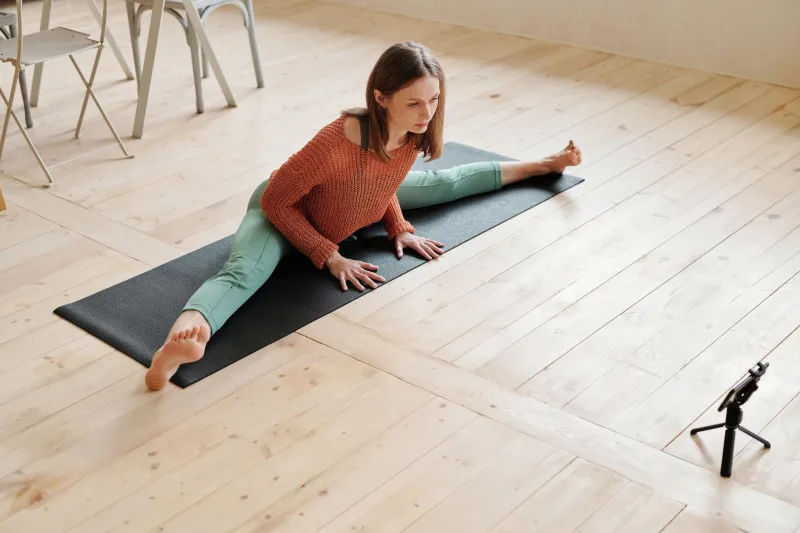
You've been putting in the work. Morning hip circles, evening hamstring holds, foam rolling before bed. For a while, things were moving in the right direction — literally. Then one day you realized you hadn't made any real progress in weeks, maybe months. Your splits aren't any deeper. Your shoulder still catches on that same overhead movement. Your thoracic spine feels like a two-by-four no matter how much you stretch it.
Welcome to the mobility plateau. It's frustrating, it's common, and the good news is that it's almost never permanent. The bad news? You're probably not going to stretch your way out of it.
Your Nervous System Is Running the Show
Here's the thing most people miss: flexibility isn't just about tissue length. Your nervous system has a massive say in how far your body is willing to move — and it's conservative by design. When you stretch, your brain is constantly asking a single question: Is this safe? If the answer is uncertain, it hits the brakes.
This protective mechanism is called the stretch reflex, and it's mediated by sensory receptors in your muscles called muscle spindles. When these spindles detect a rapid or unfamiliar change in length, your nervous system fires back with a contraction to protect the joint. Over time, consistent stretching can recalibrate this threshold — but only up to a point.
Once your nervous system has decided a given range of motion is "far enough," it stops granting access beyond that. This is your plateau. It's not a tissue problem. It's a neurological boundary, and you can't hammer your way past it with passive stretching alone.
The Myth of "Just Stretch More"
The most common response to a mobility plateau is to add more volume — longer holds, more sessions, deeper pressure. This approach feels logical, but it often backfires. Overstretching without adequate strength in the new range can actually reinforce your nervous system's reluctance to go there. Your brain learns that you can reach that position but can't control it, which is exactly the kind of information that keeps the brakes on.
Passive flexibility — the kind you get from sitting in a stretch — is only half the equation. What your nervous system actually responds to is active control. If you can't generate tension through a range of motion, your brain doesn't trust it. And ranges your brain doesn't trust are ranges it won't reliably give you.
This is a core principle behind approaches like Proprioceptive Neuromuscular Facilitation (PNF) stretching and Functional Range Conditioning (FRC), both of which have solid research backing. The common thread? They ask your muscles to do something — contract, resist, or stabilize — rather than just passively yield.
Diagnosing Your Specific Bottleneck
Not all plateaus are created equal. Before you can break through yours, you need to figure out what's actually limiting you. There are a few distinct culprits:
Passive tissue restriction. This is the classic scenario — shortened muscles, stiff fascia, or reduced joint capsule mobility. It's real, but it's less common as the primary limiter than most people think, especially in people who already have an active mobility practice.
Neurological guarding. As described above, your nervous system is simply not granting access. You might feel this as a hard stop that doesn't really feel like a stretch — more like a wall than a pull.
Strength deficits in end range. You can get there, but the moment you arrive, the joint feels unstable or unsupported. This is a motor control issue, not a flexibility issue.
Compensatory movement patterns. Your body has found a workaround. You think you're moving through your hip, but your lumbar spine is actually doing most of the work. The hip never truly gets loaded in its full range, so it never adapts.
A good physical therapist or movement coach can help you identify which of these is your primary limiter. But even on your own, paying attention to the quality of your end range — does it feel like a stretch, a wall, a wobble, or a cheat? — gives you useful information.
A Smarter Strategy for Breaking Through
Once you've got a sense of your bottleneck, the approach becomes much more targeted.
For neurological guarding: Try contract-relax techniques. Move into your end range, apply a gentle isometric contraction for 5–8 seconds, then release and explore a little further. You're essentially negotiating with your nervous system rather than forcing past it.
For end-range strength deficits: Start incorporating end-range isometrics and PAILs/RAILs (Progressive and Regressive Angular Isometric Loading). Hold your end range and actively try to push and pull against an immovable resistance. This builds the motor control that tells your brain the range is safe to inhabit.
For compensatory patterns: Slow down and isolate. Use targeted drills that force the intended joint to do the work — hip 90/90 transitions, thoracic rotations with the lumbar spine locked out, shoulder CARs (Controlled Articular Rotations) done with deliberate precision.
For passive tissue restriction: This is where longer holds and heat can actually help, but pair them with active work. Don't just lie in a stretch — breathe into the tight area, gently pulse, and finish with an active movement through the newly accessed range.
Consistency Isn't Enough — Variety Is
One more thing worth saying: if you've been doing the exact same mobility routine for six months, your body has already adapted to it. Adaptation is the goal, but once it's happened, that stimulus is no longer a challenge. Rotate your drills, change your positions, and periodically introduce movements that are genuinely unfamiliar. Novelty is a powerful training signal.
Beyond your current motion lies a version of you that moves with less friction, more control, and greater ease. Getting there isn't about pushing harder — it's about being smarter with how you ask your body to change.